
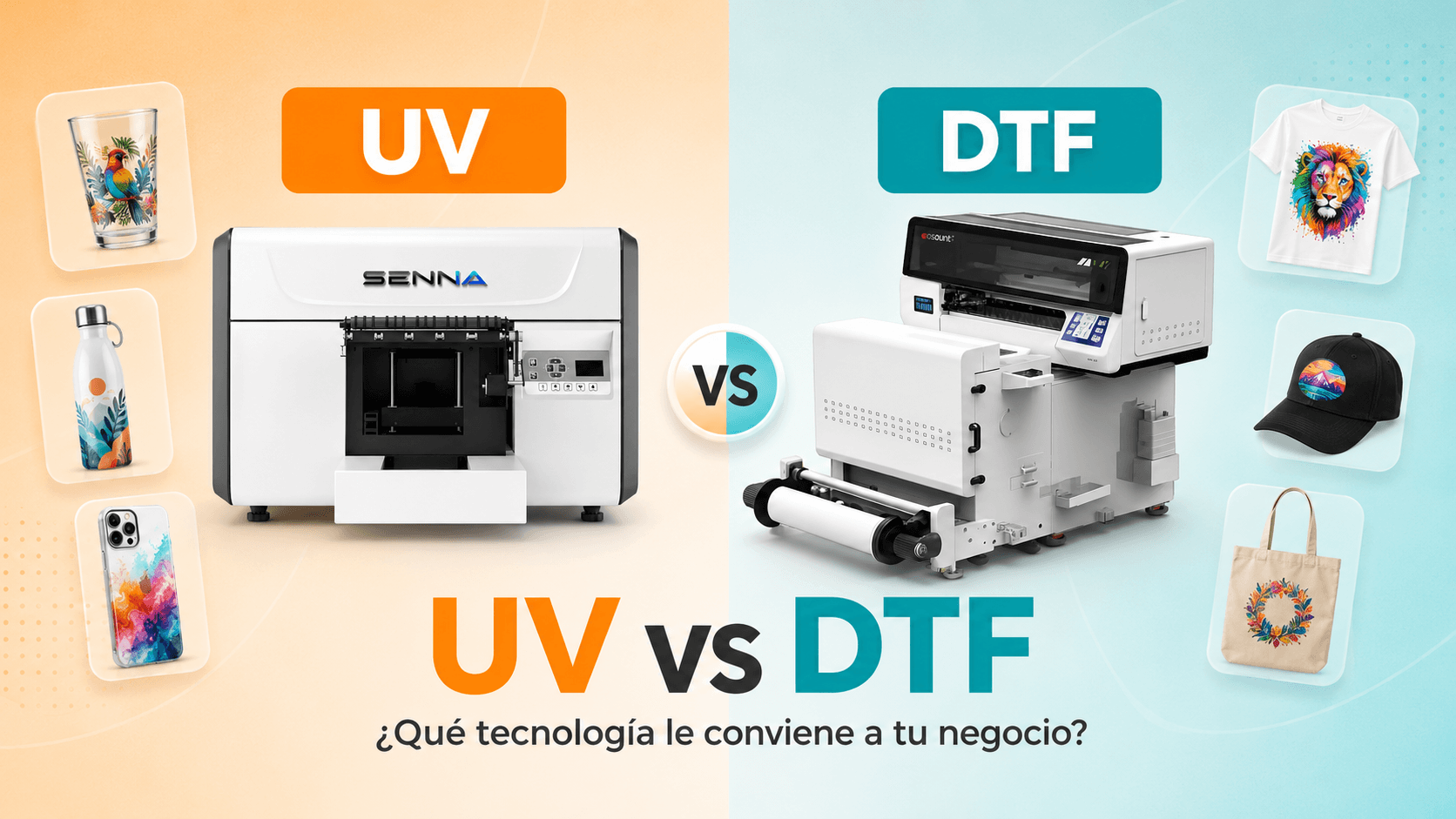
DTF is usually the best choice for textile personalization, while UV stands out when printing directly onto rigid or semi-rigid objects. The right decision depends on which products you will sell, expected volume, available space, investment, and your ability to maintain a stable production flow.
Choosing between a UV printer and a DTF printer is not about deciding which technology is “better” in absolute terms. It is about identifying which one most efficiently fulfills the type of orders your business can sell consistently. A machine with many applications is not always the most profitable investment; the best investment is the one that connects productive capacity with real demand.
In this guide we compare UV vs DTF from an operational perspective: what each system prints, what additional equipment it needs, what maintenance it requires, and which business models it usually fits best.
Quick answer: UV or DTF?
The main difference
DTF is oriented primarily toward textile transfers: the design is printed onto film, receives powder adhesive, is cured, and then heat-transferred onto the garment. UV prints and cures ink directly onto objects or substrates, making it ideal for personalizing rigid products, promotional items, plaques, acrylics, wood, glass, metal, and many other compatible surfaces.
What is DTF printing and what is it for?
DTF means direct to film. The design is printed in mirror on a PET film using color inks and white ink. Powder adhesive is then applied, curing is performed, and finally the transfer is fixed to the garment with a heat press.
Its main strength is textile versatility. It allows you to produce full-color designs, gradients, fine detail, and short runs without preparing screens. It also makes it easy to nest several logos on the same meter of film to maximize material use.
DTF usually makes sense when your business sells:
T-shirts, hoodies, uniforms, sportswear, and personalized garments.
Transfers by the meter for shops that already have a heat press.
Small or variable orders, with many designs and few units per SKU.
B2B production for apparel brands, agencies, schools, sports teams, and companies.
Minimum equipment for a DTF workflow
Besides the printer, you need a powder application and curing system — manual or automated —, RIP software, film, ink, polyamide powder, adequate ventilation, and a heat press if you will deliver the finished garment. In continuous production, integrating the printer, shaker, and oven reduces handling and improves repeatability.
What is UV printing and what is it for?
UV printing uses inks that cure with ultraviolet light. The ink comes out of the machine already dry, so you can handle the product quickly. Depending on the configuration, it can work with CMYK, white, varnish, and primer to expand compatibility and create emboss, selective gloss, or layered effects.
UV’s great advantage is printing directly onto the object. This eliminates assembly steps in many applications and opens a wide catalog of personalized products. Final compatibility depends on the material, ink, surface treatment, and adhesion; that is why tests should always be run before promising a commercial result.
UV usually makes sense when your business sells:
Phone cases, keychains, plaques, trophies, signage, promotional items, and corporate gifts.
Printing on acrylic, PVC, wood, glass, metal, leather, or other compatible substrates.
Premium products with white ink, varnish, textures, or higher-value visual effects.
Short personalized runs, prototypes, or on-demand manufacturing.
UV vs DTF comparison
- Criterion
- Textile DTF
- Direct-to-object UV
- Primary application
- Garments and textiles via transfer
- Rigid or semi-rigid objects and substrates
- Workflow
- Print → powder → cure → press
- Direct UV print and cure
- Typical products
- T-shirts, uniforms, sportswear, transfers by the meter
- Cases, plaques, acrylics, wood, metal, gifts
- Short runs
- Highly efficient
- Highly efficient
- White ink
- Essential for base and opacity on dark garments
- Essential for transparent or dark materials
- Special finishes
- Depend on film, ink, and pressing
- Varnish, emboss, selective gloss, and layers
- Additional equipment
- Shaker/oven and heat press
- May require primer, jig, or rotary accessory
- Critical maintenance
- White ink, printhead, cap, wiper, and service station
- Printhead, cap, wiper, white ink/varnish, and light control
- Ideal sales model
- Textile volume and repeat orders
- Broad object catalog with higher ticket per unit
Which offers greater profitability?
Profitability does not depend only on margin per piece. How quickly you win orders, setup time, waste, equipment availability, and the ability to repeat results without rework also matter.
DTF usually scales well when there is recurring demand for personalized apparel or meter sales to third parties. UV can achieve high tickets per unit in corporate gifts, décor, signage, and promotional products, but the catalog requires more adhesion tests, jigs, and commercial development.
Before you buy, calculate five variables
- Verifiable demand: real orders or concrete prospects, not just product ideas.
- Contribution margin: selling price minus consumables, waste, energy, and direct labor.
- Sellable capacity: meters or units you can realistically commercialize per month.
- Cost of downtime: delayed orders, wasted material, and technical hours.
- Working capital: supplies, spare parts, marketing, and months of operation while sales grow.
What to choose based on your business model
Choose DTF if your main customer buys garments
If you already sell corporate apparel, uniforms, streetwear, textile merchandising, or custom prints, DTF is usually the most direct path. A 30 cm solution can help validate demand, and a 60 cm unit with shaker lets you move toward more continuous production.
Choose UV if you sell object personalization
If your customers request gifts, signage, plaques, décor, rigid packaging, corporate pieces, or high unit-value products, UV can expand the catalog and reduce steps. Compact machines such as a UV A3 suit small products; a larger flatbed opens industrial applications and bigger pieces.
Consider both technologies only when you have a commercial plan
Having UV and DTF lets you serve textile and rigid products, but it also doubles training, consumables, routines, and spare-part needs. It is a solid strategy when each line has an owner, a defined catalog, and a monthly sales target. It does not make sense to buy two workflows just to “see what sells.”
Common mistakes when comparing UV and DTF
- Buying for maximum speed: the datasheet speed does not equal sellable production with stable quality.
- Ignoring technical service: a printer without operational continuity loses profitability even if its initial price is lower.
- Not testing materials: UV adhesion and DTF transfer performance vary by substrate and process.
- Underestimating space: oven, shaker, press, ventilation, work table, and inventory also take floor space.
- Not calculating sales: installed capacity only generates return when there is acquisition and repurchase.
Conclusion
In a UV vs DTF comparison, the right question is not which printer can do more things. It is which one can stably produce what your customers are already willing to buy. DTF is the natural option to grow in textiles; UV is the most versatile alternative for direct object personalization. The final decision should unite market, workflow, support, and numbers.
Frequently asked questions
Can a UV printer print garments?
Some UV inks can adhere to flexible materials, but they do not replace the DTF workflow for garments that must bend, stretch, and be washed. For personalized apparel, DTF is usually the more suitable option.
Does DTF work on cotton and polyester?
Yes, DTF transfer is used on a wide variety of fabrics. The result depends on the ink, powder, curing, pressure, temperature, and tests performed on each garment.
Which business is easier to start?
It depends on your customer base. DTF can be more direct if you already sell garments. UV may be better if you have access to corporate gifts, signage, or promotional products.
Which needs more maintenance?
Both require discipline. In DTF, white ink and the service station are critical. In UV you must also control printheads, wipers, caps, white ink or varnish, and accidental UV light exposure.
Can I start with a small machine and scale?
Yes. The recommended approach is to validate demand, document costs, and standardize the process before expanding width, speed, or number of printheads.
Still unsure which technology is right for you?
Tell us which products you want to sell, your expected volume, and the space available. Colpix can help you compare the full workflow, not just the printer.
Request an investment assessment → Contact