
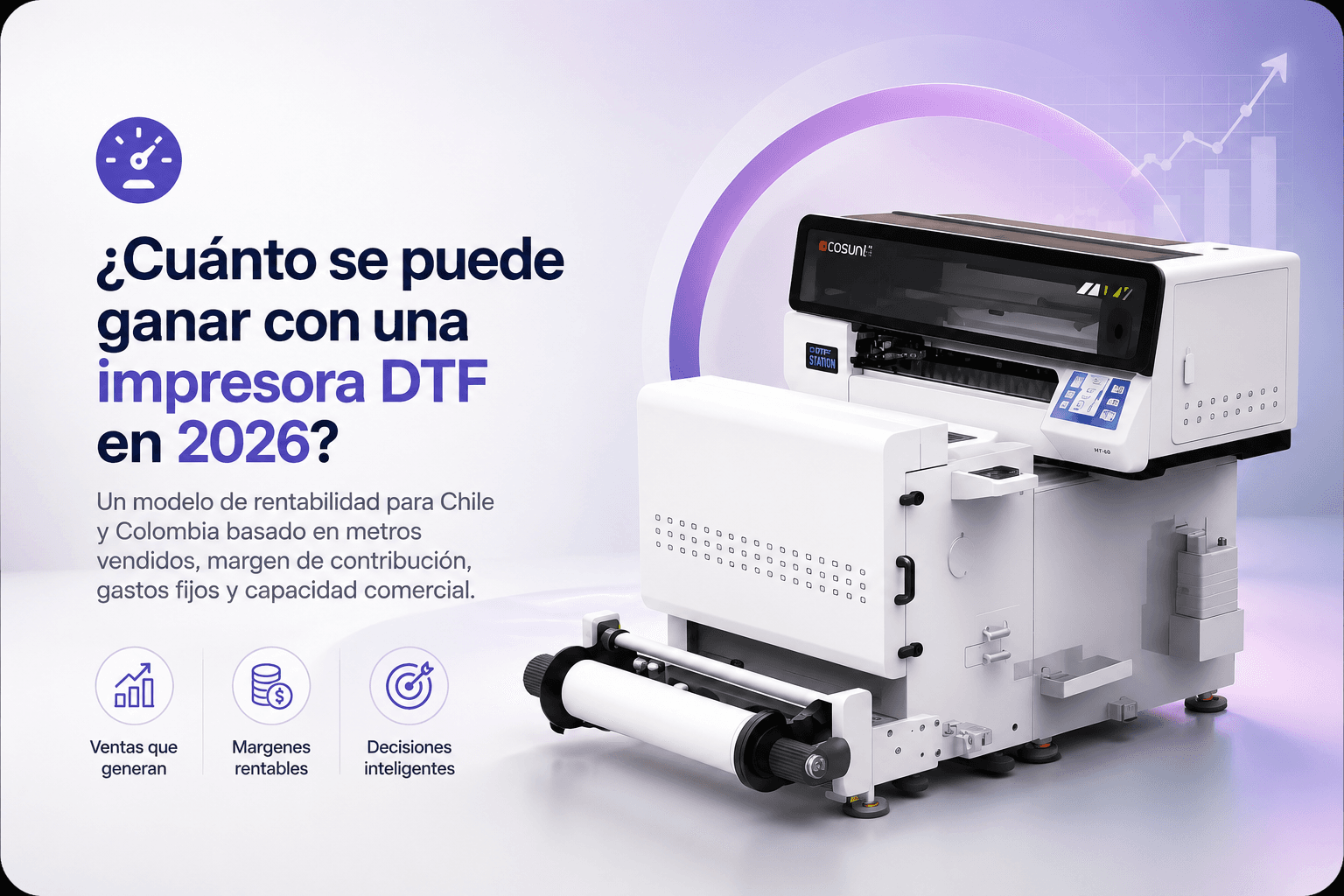
Earnings from a DTF printer depend on meters sold, price, ink coverage, waste, and fixed costs. In an illustrative scenario of 15 meters per day, operating result could be around 1.94 million CLP monthly in Chile or 2.95 million COP in Colombia, before taxes, debt, and depreciation.
Important notice
The following scenarios are illustrative models, not a profitability promise. Public prices change by city, volume, and quality. Before publishing, Colpix should replace variable costs with real RIP, consumable, waste, energy, and service data from its operators.
The question “how much do you earn with a DTF printer?” is often answered with an eye-catching figure, but a machine does not generate revenue just by being powered on. Profitability appears when demand exists, the operator sells meters or garments on a recurring basis, and the process maintains stable quality.
It is also useful to clarify the term operator. A hired operator receives a wage based on the labor market. In this article we analyze the operator-entrepreneur or business owner who commercializes the production of their printer.
The basic DTF profit formula
To estimate monthly results, use this structure:
Formula
Operating result = monthly sales − variable costs − fixed expenses. Variable costs grow with each meter; fixed expenses exist even when the machine produces little.
Variable costs you must include
- DTF film actually consumed, including gaps and startups.
- CMYK and white ink according to coverage recorded by the RIP.
- Adhesive powder, waste, rejected material, and reprints.
- Direct energy for printer, shaker, oven, and press.
- Direct labor when paid by production.
- Packaging, payment commissions, and shipping attributable to the order.
Fixed expenses that are often overlooked
- Rent or share of space, internet, software, and administration.
- Operator salary, even if it is the owner’s own.
- Marketing, sales support, and cost of acquiring customers.
- Preventive maintenance, spare parts, and a reserve for printheads.
- Financing, insurance, and equipment depreciation.
- Taxes, which must be calculated according to the country and legal structure.
Three DTF business models
- Model
- What you sell
- Advantage
- Main challenge
- Printed meter
- Cured film ready to press
- Fast workflow and recurring B2B sales
- Price competition and meter utilization
- Transfer by design
- Cut logos or pieces
- Higher value per area used
- Prep, sorting, and handling of small orders
- Finished garment
- T-shirt, uniform, or ready product
- Higher potential ticket and margin
- Textile inventory, pressing, sizes, returns, and sales
The same meter can yield very different results. Selling it whole simplifies operations. Selling separate designs can raise revenue per area. Delivering the finished garment adds value, but also increases work, inventory, and commercial risk.
Reference prices observed in Chile and Colombia
A sample of public offers reviewed in July 2026 showed DTF selling prices of approximately 10,000 to 16,990 CLP per meter of 58–60 cm in Chile, depending on volume and supplier. In Colombia, references near 19,900–25,000 COP per meter were observed. These values are not an official rate and do not necessarily include the same ink, profile, coverage, warranty, or service level.
To build the scenarios we will use 14,000 CLP per meter in Chile and 23,000 COP in Colombia, within those public samples. Variable costs of 4,500 CLP and 8,000 COP per meter are editorial assumptions that should be replaced with real data before presenting the article as “based on Colpix operators.”
Illustrative scenario: Chile
- Pace
- Meters/month
- Sales
Variable costs
Contribution
Fixed expenses
- Operating result*
- 6 m/day
- 132
- $1.848.000
- $594.000
- $1.254.000
- $700.000
- $554.000
- 15 m/day
- 330
- $4.620.000
- $1.485.000
- $3.135.000
- $1.200.000
- $1.935.000
- 30 m/day
- 660
- $9.240.000
- $2.970.000
- $6.270.000
- $2.000.000
- $4.270.000
- *Result before taxes, financing, depreciation, and owner draws. Assumptions: 22 working days, price of 14,000 CLP/m and variable cost of 4,500 CLP/m.
Break-even for the mid scenario in Chile
With fixed expenses of 1,200,000 CLP and a contribution of 9,500 CLP per meter, the break-even point is approximately 127 meters per month, equivalent to 5.8 meters per day over 22 days. From that volume onward, each additional meter contributes toward recovering investment and generating profit.
Illustrative scenario: Colombia
- Pace
- Meters/month
- Sales
Variable costs
Contribution
Fixed expenses
- Operating result*
- 6 m/day
- 132
- $3.036.000
- $1.056.000
- $1.980.000
- $1.200.000
- $780.000
- 15 m/day
- 330
- $7.590.000
- $2.640.000
- $4.950.000
- $2.000.000
- $2.950.000
- 30 m/day
- 660
- $15.180.000
- $5.280.000
- $9.900.000
- $3.500.000
- $6.400.000
- *Result before taxes, financing, depreciation, and owner draws. Assumptions: 22 working days, price of 23,000 COP/m and variable cost of 8,000 COP/m.
Break-even for the mid scenario in Colombia
With fixed expenses of 2,000,000 COP and a contribution of 15,000 COP per meter, the break-even point is approximately 134 meters per month, equivalent to 6.1 meters per day over 22 days.
Why selling 30 meters a day does not guarantee large profits
High production can hide aggressive discounts, jobs with excess white ink, poor film nesting, reprints, customer credit, or idle time. It may also require a second operator, more space, inventory, and a constant commercial strategy.
That is why the main KPI should not be “meters printed,” but contribution margin per available hour. A meter sold with low coverage and a press-ready file can be far more profitable than a fragmented, urgent, poorly prepared order.
How to increase profitability without printing more hours
- Nest designs and charge for prep when the customer delivers messy files.
- Define volume price tiers without destroying the minimum margin.
- Sell value-added services: file review, color, cutting, sorting, or pressing.
- Reduce waste with standardized widths, margins, and templates.
- Build B2B repurchase with brands, schools, uniforms, agencies, and shops.
- Record real consumption per job to identify unprofitable customers or designs.
- Protect equipment availability with maintenance and stock of critical spare parts.
Quick calculator for your own business
- Variable
- Your figure
- Meters sold per day
- _____
- Productive days per month
- _____
- Average price per meter
- _____
- Real variable cost per meter
- _____
Monthly fixed expenses
- _____
- Result = meters × (price − variable cost) − fixed expenses
- _____
Conclusion
A DTF printer can become a profitable business, but earnings are not calculated from the machine’s maximum speed. They are calculated from meters sold, average price, real cost, availability, and fixed expenses. A mid scenario of 15 meters per day can produce an attractive operating result, provided there is recurring demand and the operator controls waste, maintenance, and customer acquisition.
Frequently asked questions
How much does it cost to produce one meter of DTF?
There is no universal cost because it changes with width, white ink coverage, profile, film, powder, energy, waste, and maintenance. Use the RIP log and your actual purchases to calculate it.
How many meters must I sell to cover expenses?
Divide your fixed expenses by the price per meter minus the variable cost per meter. That result is your monthly break-even point.
Is it more profitable to sell meters or garments?
The finished garment can leave a higher margin per order, but it requires inventory, a press, labor, sizes, quality control, and marketing. Selling meters is simpler and more scalable in B2B.
How long does it take to pay off a DTF printer?
It depends on total investment and monthly operating cash flow. Divide the investment by conservative monthly cash flow, including working capital and startup months. Do not treat gross profit as if it were available cash.
What figure should I review every week?
Meters sold, average price, real variable cost, waste, availability, accounts receivable, and contribution margin per productive hour.
Turn machine capacity into a business plan
Colpix can help you size equipment, consumption, break-even, and operational continuity for your market and expected volume.
Request a profitability analysis → Contact